
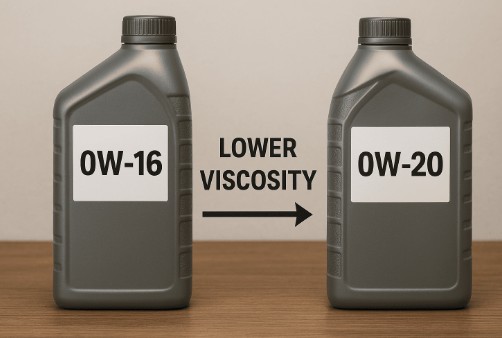
The main difference between 0W16 vs 0W20 engine oil is their viscosity at operating temperature. Both oils flow similarly in cold conditions, but 0W-16 is thinner when the engine is hot, which can help improve fuel efficiency. 0W-20 is slightly thicker, offering a bit more protection under higher temperatures and heavier loads. Always use the oil grade recommended by your vehicle manufacturer for the best engine performance and longevity.
It’s a crisp Saturday morning. You’re standing in the auto parts aisle, coffee in hand, staring at two jugs that look almost identical. You hear that familiar, rhythmic tick-tick-tick of a cold engine in your head—the sound of your car struggling to wake up in the freezing driveway. Now, you’re looking at 0W-16 and 0W-20. The prices are nearly the same. You’re tempted to just grab the cheaper one and hope for the best, right? I’ve been in that exact spot, and honestly, I’ve been tempted to do the same.
Top 5 Best Engine Oil for Car: Top Valvoline Picks for Maximum Performance
But after digging through stacks of OEM specs and chatting with a few seasoned mechanics, I learned that the 0W-16 vs 0W-20 debate isn’t just about price. Does that subtle difference actually matter for your engine? The short answer is yes—sometimes it matters a lot. Let’s break down the viscosity, compatibility, and fuel economy differences so you can walk out of that aisle with confidence.
Quick-Reference Comparison: 0W-16 vs 0W-20
| Property | 0W-16 | 0W-20 | Winner For… |
| Cold-start flow | Slightly thinner | Slightly thicker | 0W-16 (cold climates) |
| Hot film thickness | Thinner | Thicker | 0W-20 (worn engines) |
| Fuel economy | Marginally better | Good | 0W-16 |
| Engine protection | Modern tight tolerances | More cushion | 0W-20 |
| OEM compatibility | New hybrids/Japanese | Wide range | 0W-20 |
| Price | Less common | Often cheaper | 0W-20 |
| ILSAC standard | GF-6B | GF-6A | OEM requirement |
What Do Those Numbers Even Mean? (0W-16 vs 0W-20 Explained)
The numbers you see on oil bottles are an SAE viscosity code. The “0W” prefix tells you both oils flow at the same rate in freezing weather; the “W” stands for winter, not weight. The second number (16 vs 20) measures how thick the oil stays when your engine reaches operating temperature. A lower number means the oil is thinner when hot. That is really the only difference.
Breaking Down the SAE Viscosity Rating
I used to think the “W” stood for “weight,” but I learned the hard way that it actually stands for “winter.” Both 0W-16 and 0W-20 are designed to flow easily during that dreaded cold start. Think of it like comparing maple syrup to water on a warm summer day. When cold, both are thick, but the oil is engineered to thin out rapidly as your engine warms up to protect moving parts.
Modern engines are built with incredibly tight manufacturing tolerances. They need that thinner oil to slip into tiny gaps between metal parts. While terms like kinematic viscosity and high-temperature high-shear (HTHS) viscosity sound like something out of a chemistry lab, they basically just describe how well that oil film stays in place under pressure. Keeping that film strong is key to preventing metal-on-metal wear.
The Multigrade Oil Concept — Why One Oil Does Both Jobs
It wasn’t always this simple. Back in the day, my dad used to change his oil weight every time the seasons shifted. It was a massive chore. Thankfully, we now have multigrade oils. These use clever polymer additives that act like little springs, changing how the oil behaves across different temperatures.
This viscosity index is what allows a single bottle of oil to work in both a frosty morning and a hot afternoon commute. Without these additives, you would be stuck in the driveway every few months just to swap fluids. It’s one of those bits of modern engineering we take for granted until we’re stuck at the auto parts store on a Sunday, wondering if we really need to be that picky.
Real-World Performance: How Each Oil Behaves in Your Engine
In real-world driving, the difference between 0W-16 and 0W-20 comes down to two specific moments: a frigid February startup and your long-term fuel efficiency. 0W-16 is slightly thinner when hot, which cuts down on internal friction and can bump your fuel economy by a small margin. Meanwhile, 0W-20 is a touch thicker, offering a bit more protection for older engines. Day-to-day, they perform very similarly.
Cold Start Performance — The Moment That Matters Most
Most engine wear happens the second you turn that key. Mechanics often agree that the majority of engine damage occurs during those first few seconds of a cold start. Because both are “0W” oils, 0W-16 and 0W-20 perform almost exactly the same when you start your car.
Think back to a freezing morning in Minnesota versus a mild commute in Phoenix. In the cold, you hear that sluggish tick-tick-tick until the oil begins to circulate. After about five minutes, the engine warms up, and everything runs smoothly. Regardless of which oil you pick, the “0W” prefix ensures your engine gets the protection it needs the moment it starts moving.
Hot Engine Protection and Oil Film Thickness
The oil film is what keeps metal parts from rubbing against each other. At operating temperatures, 0W-20 provides a slightly thicker HTHS viscosity than 0W-16.
Does this mean 0W-16 is weak? Not at all. Modern engines are built with such tight, precise tolerances that they are specifically engineered for that thinner oil. However, if you are driving an older, high-mileage vehicle or regularly deal with extreme towing conditions, that extra “cushion” from a 0W-20 oil can be helpful.
Fuel Economy — The Difference You Might Actually Feel at the Pump
Lower viscosity means less internal resistance for your engine, which leads to better gas mileage. Switching to a thinner oil like 0W-16 might give you a small boost, but be realistic.
- The reality: You might see a 0.5% to 1% improvement in fuel economy.
- The trade-off: If you drive a Prius, your owner’s manual has already decided this for you, and it’s usually 0W-16 for a reason.
Exact MPG gains vary wildly based on your driving style and local climate. Don’t trust anyone who promises a massive, specific fuel savings number without knowing your exact car and how you drive it.
Which Cars Use 0W-16 vs 0W-20? (OEM Specifications)
The simplest answer? Check your owner’s manual—that’s your official OEM oil spec, and it overrides everything you’ll read online, including this article. As a rule, 0W-16 is the factory requirement for many newer Toyota and Honda hybrids. 0W-20 is much broader, used in Subaru, older Hondas, and Ford EcoBoost engines. Always stick to what the manual says; it is the final word on what keeps your engine happy.
Vehicles That Specify 0W-16
Manufacturers are shifting toward 0W-16 to meet strict fuel economy standards and accommodate modern, precise engine designs. You will typically find this in:
- Toyota: Camry Hybrid (2018 and newer), RAV4 Hybrid, newer Corolla trims, and most Prius models.
- Honda: Civic (2022 and newer), plus the latest CR-V and HR-V platforms.
- Mazda: Select 2020 and newer models equipped with Skyactiv-X engines.
Vehicles That Specify 0W-20
This grade is a workhorse in the automotive world. It is the go-to for a huge range of Japanese-market vehicles and many domestic turbo engines. You will often see this spec for:
- Toyota & Lexus: Older models or non-hybrid trims.
- Subaru: Most FA and FB engines.
- Honda & Acura: Many models produced between 2015 and 2021.
- Ford: Many EcoBoost 1.5L and 2.0L engines, plus some F-150 variants.
- Hyundai/Kia: Always verify your specific year, as some require 5W-20 or 5W-30 instead.
Can You Use 0W-20 in a Car That Calls for 0W-16?
I know, sometimes you’re in a pinch on a Sunday afternoon, and the shelf only has 0W-20. Can you use it? The short answer is that you will likely be fine in a temporary emergency. However, I strongly advise against it for the long term.
Using the wrong oil can technically create a headache for your powertrain warranty. If you accidentally put 0W-20 in a 0W-16 engine, it is not a catastrophic event, but the engine won’t run with the efficiency it was designed for. Conversely, putting 0W-16 in an older car that calls for 0W-20 is a bigger concern. Older engines often lack the tight tolerances needed for such thin oil, which could lead to increased wear or oil consumption.
My best advice? If the manual says 0W-16, buy the 0W-16. It’s not just a suggestion from the manufacturer; it’s a vital part of how your car was engineered to live a long, healthy life.
0W30 vs 5W30 – Cold Start Performance & Engine Protection Compared
The API and ILSAC Standards: What GF-6A and GF-6B Actually Mean for You
Most people just ignore the small print on the back of the bottle, but you shouldn’t. The GF-6A and GF-6B labels are vital certifications. They prove the oil is built for modern engines to stop issues like low-speed pre-ignition (LSPI) and timing chain wear. Generally, 0W-20 uses GF-6A, while 0W-16 uses GF-6B. If your manual calls for one, don’t settle for the wrong certification.
GF-6A vs. GF-6B — The Practical Difference
The ILSAC GF-6 standard arrived in 2020 to replace the older GF-5. It was a massive step forward for engine health.
- GF-6B: This is specifically for 0W-16 and thinner oils. It is not backward compatible, meaning you cannot use it in older cars designed for heavier weights.
- GF-6A: This covers 0W-20 and thicker oils. It is backward compatible, which makes it a safe bet for many older vehicles.
Why does this matter? If you drive a modern, turbocharged, direct-injection engine, your car is prone to LSPI—a violent knocking that can ruin an engine in seconds. These new standards include strict phosphorus limits and better oxidation stability to keep that “knocking” from ever happening.
What to Look for on the Oil Bottle
When you are in the store, look for the API “donut” on the label. The top half shows the performance rating (like API SP), while the bottom shows the resource-conserving status. You also want to see the ILSAC starburst symbol, which tells you the oil meets the latest energy-saving requirements.
For any car calling for 0W-16 or 0W-20, full synthetic is the only way to go. Synthetic blends often meet the viscosity number, but they fall short on the advanced deposit control and additive packages your engine needs. Think of it as premium fuel for your internal parts—don’t skimp here.
0W-16 vs 0W-20: Which Is Better for High-Mileage Engines?
If your daily driver has passed the 75,000-mile mark, pay close attention. High mileage often brings a bit of wear to piston rings and bearings. These parts rely on a solid oil film to stay protected. In these cases, the slightly thicker hot-viscosity of 0W-20 can offer a subtle safety net. However, if your owner’s manual strictly demands 0W-16, jumping to a thicker oil might cause more friction than it solves.
Signs Your Engine Might Prefer a Slightly Thicker Oil
Your car will often tell you when it’s getting tired. Watch for these red flags:
- Oil consumption: You find yourself topping off the oil between changes because it seems to be “disappearing.”
- Startup noise: You hear a distinct ticking sound on a cold morning that takes longer to fade away than it used to.
- Vehicle Age: Most engines built before 2015 were not engineered for the super-thin 0W-16 grade.
- Heavy work: If you frequently tow trailers or haul heavy loads, your engine runs hotter and works harder.
High-Mileage Oil Formulas — A Third Option Worth Knowing
If your older car is burning oil, you might look at “high-mileage” specific formulas. These oils include special seal conditioners to help stop leaks and often have higher levels of ZDDP (zinc) to protect older metal surfaces.
While you can easily find high-mileage 0W-20 on the shelf, you will struggle to find a high-mileage 0W-16. That’s just the market reality—most cars using 0W-16 are still relatively new. Look, your 2009 Accord has seen things. It has handled road trips to Vegas, three different college roommates, and over 100,000 miles of life. Give it the oil it needs to stay reliable, not the one it was born with. When in doubt, talk to a trusted mechanic before switching grades.
Oil Change Intervals: Does the Viscosity Grade Affect How Often You Change It?
Viscosity grade and oil change intervals are two very different things. Whether you use 0W-16 or 0W-20, a good full synthetic oil should safely last between 5,000 and 10,000 miles under normal driving conditions. The grade itself doesn’t change how fast the oil breaks down. Instead, your actual oil life depends on your driving habits, engine load, temperature cycles, and the quality of the synthetic oil you choose.
How Oil Life Monitors (OLM) Calculate Drain Intervals
Modern cars are much smarter than the ones I grew up with. Your Oil Life Monitor (OLM) isn’t just counting down miles. It uses a complex algorithm to track engine temperature, RPMs, and load. It knows exactly how hard your engine is working.
I remember taking my old sedan to a shop years ago, and the mechanic insisted I come back every 3,000 miles. They weren’t lying about the benefits of fresh oil, but they definitely wanted my repeat business! With modern full synthetic oils, that “3,000-mile rule” is officially a thing of the past. If you use high-quality oil, you can trust your car’s computer to tell you when it’s actually time for a change.
When to Change Sooner — Conditions That Shorten Oil Life
Sometimes, you need to ignore that dashboard light and change your oil early. Certain conditions put extra stress on your engine and degrade the oil faster than normal:
- Short Trips: If your engine never fully warms up, moisture builds up in the oil. This is arguably the worst thing you can do for your engine’s health.
- Extreme Weather: Living in a place with punishing heat or bitter cold forces your oil to work overtime.
- City Driving: Constant stop-and-go traffic creates more heat cycles and friction than steady highway cruising.
- Tough Environments: If you drive on dusty roads or go off-road, your oil picks up contaminants much faster.
If your driving life is filled with these challenges, don’t wait for the OLM to hit 0%. Changing your oil a little early is cheap insurance. It’s a small price to pay to keep your engine running smoothly for years to come.
Price, Availability, and Choosing a Brand: What to Know Before You Buy
Finding 0W-20 is easy—it is everywhere, from big-box stores to local auto parts shops, typically costing $8–$12 per quart. 0W-16 is a bit harder to find in person and often carries a higher price tag. For either grade, my advice is the same: look for API-certified, full synthetic oil from a reputable brand. The name on the bottle matters much less than the certification stamp on the back.
Top-Rated 0W-16 Oils (2025–2026)
Because 0W-16 is a newer standard, it isn’t stocked as heavily as older grades. Here are the ones I trust:
- Mobil 1 Advanced Fuel Economy 0W-16: Very reliable and widely available for those who need Toyota-approved specs.
- Pennzoil Platinum 0W-16: I’ve found this works exceptionally well for keeping engine deposits under control.
- Castrol Edge 0W-16: Known for a strong titanium additive package that helps with oil film strength.
- Toyota Genuine Motor Oil 0W-16: It’s an OEM product, so you know it’s perfect, though you will pay a “dealer premium” at the register.
Top-Rated 0W-20 Oils (2025–2026)
Since 0W-20 is so common, the market is packed with options:
- Mobil 1 Extended Performance 0W-20: Often claims to last up to 15,000 miles, though I still recommend following your car’s oil life monitor.
- Valvoline Advanced Full Synthetic 0W-20: This is my go-to “workhorse” oil; it’s solid, affordable, and easy to find.
- Pennzoil Ultra Platinum 0W-20: Uses gas-to-liquid technology, which is genuinely impressive for cold-flow performance.
- Amsoil Signature Series 0W-20: If you are an enthusiast who keeps your car for the long haul, this is the premium choice.
Is Dealer Oil Really Better?
Whenever I’m at the dealer, the service advisor always hints that their “factory-fill” oil is superior. Honestly? It’s usually the same spec as the high-end stuff you find at the store, just with a much higher markup. You are paying for the convenience of them doing the work.
As long as you buy a certified, full synthetic oil, you are protecting your engine just as well as the dealer would. One quick tip: if your car is still under warranty, keep your receipts! If you ever have a powertrain issue, you need that proof that you used the right oil, regardless of whether you bought it at the dealer or a warehouse store.
FAQ: Common Questions About 0W-16 vs 0W-20
This section covers the questions that keep popping up in forums and comment sections—and, honestly, in my own search history at 11 p.m. when I realized I grabbed the wrong jug at the store. If you are standing in the aisle right now and just need a quick, direct answer without the fluff, you have come to the right place.
Can I mix 0W-16 and 0W-20?
Short answer: It won’t blow up your engine, but don’t make a habit of it. Mixing them thins the 0W-20 and messes with the balance of the additives. If you are low on oil on a Sunday and it’s all you have to get home, go ahead and use it. Just make sure to do a proper oil change with the correct grade as soon as you can.
Is 0W-16 better than 0W-20?
“Better” isn’t the right word; “more appropriate” is. 0W-16 is better if your engine was engineered for it. 0W-20 is better if that is what your manual calls for. If your car is approved for both, 0W-16 is the winner for fuel economy, but 0W-20 is often easier to find on the shelf.
What happens if I put 0W-20 in a car that needs 0W-16?
You get a slightly thicker oil film, which sounds good, but it also creates more internal friction. Modern engines are built with very tight tolerances; they are designed to work perfectly with that thinner 0W-16 flow. In the short term, you’ll be fine. Long-term, you might see a tiny dip in gas mileage or increased engine wear. Stick to the spec.
Does climate affect which oil I should use?
Both oils have the same “0W” rating, so they perform equally well when you turn the key on a freezing winter morning. In extreme heat, the thicker hot-side of 0W-20 could technically offer a tiny bit more cushion. However, the difference is negligible for most drivers. Stick to your owner’s manual before worrying about the local weather forecast.
How do I know which oil my car actually needs?
Check these three things, in this order: your owner’s manual, the label on your oil cap, and your manufacturer’s website. Do not trust the random sticker on your windshield from the last oil change shop, and definitely don’t trust what the previous owner told you. When in doubt, search your VIN on the official OEM site.
The Bottom Line: 0W-16 or 0W-20 — Just Use What Your Car Needs
There is no universal winner here. 0W-16 is the better fit if your engine was designed for it—you get slightly better fuel economy and full compatibility with the latest standards. 0W-20 is the safer, more widely available choice for a massive range of vehicles. The right answer is almost always waiting for you in your glove box. Go read it.
Quick Decision Guide — Which Oil Should You Buy?
| Your Situation | Recommended Choice |
| OEM specifies 0W-16 | Use 0W-16 (GF-6B certified) |
| OEM specifies 0W-20 | Use 0W-20 (GF-6A certified) |
| High-mileage (75k+) and 0W-20 | Consider high-mileage 0W-20 |
| Manual is lost | Look up VIN at OEM website |
| Both are approved | 0W-16 for MPG, 0W-20 for availability |