
The LF2008 Oil-Based Dye is the pick, mainly because its twin-neck bottle fits standard syringe injectors and one 8oz bottle services up to eight vehicles. Choosing an oil leak detection dye for engines requires more than picking any glowing liquid off a shelf.
Most bottles look identical, yet they’re mixed for very different jobs. Some dyes vanish in dark, dirty oil, while others are built specifically to cut through it. Before this page recommends anything, you’ll learn what actually separates a good tracer from one that just wastes your time. We’ll cover why bottle shape matters more than volume and what you must already own before you order.
| # | Product | Best for | Price |
|---|---|---|---|
| 1 | Tracer Products TP-3090-0601 | Best Overall | Check price on Amazon |
| 2 | LF2008 Oil-Based Dye | Largest Single Bottle | Check price on Amazon |
| 3 | Oil-Based UV Leak Dye | Best for Dirty Oil | Check price on Amazon |
| 4 | Fluorescent Oil Leak Tracer | Best Multi-Pack | Check price on Amazon |
| 5 | ACDelco 1148963 Fluorescent Dye | OEM Trusted Brand | Check price on Amazon |
| 6 | AutoPro Engine Oil Dye | Best Multi-System | Check price on Amazon |
| 7 | Engine Oil Dye Kit | Best All-in-One Kit | Check price on Amazon |
What To cONSIDR WHEN CHOOSING Oil Leak Detection
Fluid Compatibility
Not every fluorescent tracer works in every fluid under your hood. A dye formulated strictly for engine oil might break down or fail to glow when you add it to automatic transmission fluid or power steering lines. Multi-purpose formulas exist, but you still have to read the label carefully to confirm which systems they cover.
Using the wrong type can leave you staring at a dark engine bay wondering why nothing lights up. Before ordering, check the listing’s compatibility list against the exact fluids in your vehicle. If you need to trace leaks across different systems, a single universal formula saves you from buying multiple bottles. You can verify fluid types by checking GM Original Equipment specifications for your specific vehicle.
Bottle Design and Application
The way dye gets into your engine matters just as much as the liquid itself. Wide-mouth bottles often lead to spills on valve covers and hands, making cleanup frustrating before you even start the engine. Twin-neck bottles or those with pointed precision nozzles let you control exactly how much goes into the fill tube.
Some setups require a separate syringe injector, meaning the dye alone won’t do the job without extra tools. Look closely at the application method described in the listing. Measure your filler neck opening if you’re unsure whether a specific nozzle will fit without dripping everywhere.
Visibility in Used Oil
Fresh oil is amber and clear, but used engine oil turns black quickly from heat and carbon buildup. Standard dyes that glow brightly in clean fluid often get swallowed up by dark, dirty oil, hiding the very leak you’re trying to find. Formulations designed specifically for dirty conditions use fluorescent tracers that push through the grime. This is the feature that sells the product but rarely earns its place if your oil was just changed yesterday. Check whether the listing explicitly mentions performance in dark or used oil. If you haven’t changed your oil recently, this distinction decides whether you see the leak or not.
Remaining in the System
Some buyers assume they must flush the dye out immediately after finding the leak. However, certain formulas are engineered to remain safely inside the system indefinitely for long-term monitoring. Others might crystallize or separate if left too long, potentially causing issues in tight oil passages. Knowing whether a dye is safe to leave behind changes how you plan your repair schedule. Read the listing to see if the manufacturer states it’s safe for continuous circulation. Count the days you plan to drive before your next oil change to ensure the dye matches your timeline.
1. Tracer Products TP-3090-0601 Gas Engine Oil dye
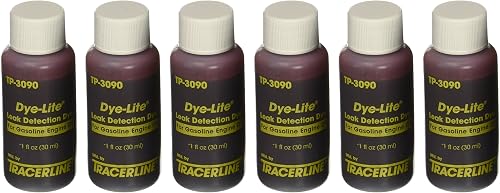
Best for: Shops needing multiple small doses of gasoline engine dye.
This Tracer Products entry comes as a six-pack of 1 oz. bottles made specifically for gasoline engine oil. Because it’s produced with the highest grade materials according to the listing, you’re getting a focused formula rather than a diluted multi-purpose mix.
Having six individual bottles means you can keep one in different toolboxes without worrying about a large bottle leaking during transport. The trade-off here is capacity; if you’re running a shop where you service many cars daily, 1 oz. per bottle runs out fast compared to larger options.
When judging this against fluid compatibility, it locks you into gasoline engines only. It doesn’t claim to work in diesel, power steering, or transmission systems, so you’d need another product for those. The small size makes application straightforward, though it lacks a specialized nozzle or twin-neck design for measured dosing. This product isn’t for someone working on diesel trucks or needing a universal shop dye, since its formulation targets gas engines exclusively.
Pros:
- Six individual 1 oz. bottles prevent cross-contamination
- Made with highest grade materials
- Specifically formulated for gasoline engines
- Easy to store in multiple locations
Cons:
- Only works in gasoline engine oil
- Small 1 oz. bottles empty quickly
2. LF2008 Automotive Oil-Based Fluid Leak Detection Dye

Best for: High-volume shops using syringe-style injectors daily.
LEAKFINDER provides an 8oz bottle featuring a twin-neck design meant for use with syringe-style injectors. That twin-neck shape eliminates guesswork during application, ensuring accurate dosing while reducing spills around your tools and engine surfaces. One bottle services up to eight vehicles, which changes how you stock your shop compared to buying single-use vials. The high-visibility fluorescent dye circulates through the system and glows yellow-green under UV light to reveal micro, hidden, and intermittent leaks.
Looking at visibility in used oil, this professional-grade formula aims to reduce diagnostic time across multiple systems. It finds leaks in oil, fuel, ATF, and power steering, giving it broad compatibility. However, the package contains the UV dye bottle only, meaning the injector, hose, and UV flashlight are sold separately.
If you don’t already own those tools, you can’t use this product right out of the box. It isn’t for a DIYer who wants a complete kit ready to go immediately, since it requires purchasing additional equipment. Proudly made in the USA, it works with all leak detection flashlights.
Pros:
- Services up to eight vehicles per bottle
- Twin-neck bottle ensures accurate dosing
- Works in oil, fuel, ATF, power steering
- Glows yellow-green under UV light
- Made in the USA
Cons:
- Injector and flashlight sold separately
- Requires syringe-style injector for use
3. Oil-Based UV Leak Dye

Best for: Finding slow seepage in dark, dirty engine oil.
Yesibeike formulates this 5.07 fl oz dye specifically for dark used oil conditions where leaks are hard to see. That focus directly addresses the visibility decision, helping trace engine oil leak paths even when the fluid is thick with carbon. The pointed precision nozzle helps place dye into the fill point with better control, reducing dripping and mess around your hands. It also features a low-odor formula, making it easier to work with during extended leak checks in enclosed garages.
For compatibility, it handles engine oil, fuel, ATF, power steering, and hydraulic fluid systems. It helps trace small seepage and slow leaks around oil pans, gaskets, seals, hoses, and tight service areas. You must shake the bottle well before use because some settling may occur after storage.
This step is mandatory to keep the fluorescent tracer evenly mixed for a consistent check. It isn’t for someone who wants to grab a bottle and pour immediately without prep, since skipping the shake could result in uneven fluorescence. Add only the needed amount, circulate the fluid, inspect with UV light, then clean visible dye after repair.
Pros:
- Designed specifically for dark used oil
- Pointed nozzle reduces dripping and overuse
- Low-odor formula improves workspace comfort
- Covers oil, fuel, ATF, and hydraulics
Cons:
- Must shake well before each use
- Settling occurs during storage
4. Fluorescent Oil Leak Tracer
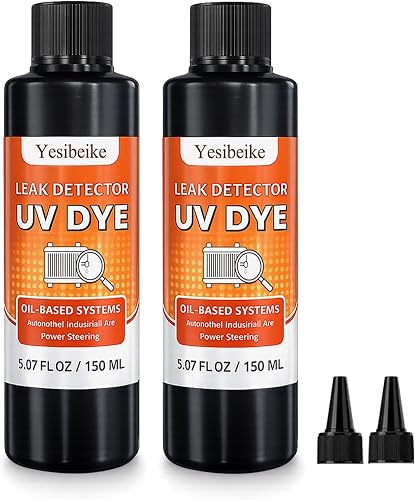
Best for: Keeping backup dye in multiple service bays.
This Yesibeike option arrives as a two-pack, with each bottle holding 5.07 fl oz of fluorescent tracer. Buying a multi-pack changes your workflow because you don’t have to stop mid-job to order more when a bottle runs dry. It’s made for leak checks in engine oil, ATF, power steering fluid, and hydraulic fluid systems. Like the single version, it helps make difficult-to-see fluid paths more visible under a compatible UV inspection light, especially in dark used oil.
The precision nozzle supports controlled, non-pressurized application, directing the tracer into the fill point to reduce mess around tools. You can inspect common leak points like gaskets, seals, fittings, lines, and pumps in tight service areas.
Storage requires attention here: you must tighten the cap after use and store the bottles upright in a cool, dry place. Light oil marks may appear on the bottle label during handling, though this doesn’t affect the liquid inside. It isn’t for someone who tosses tools loosely into a rolling cart, since improper storage could lead to leaks or settling issues.
Pros:
- Two 5.07 fl oz bottles included
- Precision nozzle prevents messy applications
- Targets oil, ATF, power steering, hydraulics
- Effective in dark used oil conditions
Cons:
- Must store upright in cool place
- Label may show oil marks from handling
- Requires shaking due to potential settling
5. ACDelco 1148963 GM Original Equipment 10-5045 Multi-Purpose Fluorescent Leak Detection

Best for: Owners wanting factory-matched GM component compatibility.
ACDelco labels this 1 oz bottle as GM Original Equipment, meaning it’s the exact multi-purpose fluorescent leak detection dye used in dealership service bays. It works with gasoline and diesel engine oil, power steering fluid, and automatic transmission fluid.
The standout feature here is that it’s specially formulated to safely remain in the system after the leak detection is complete. This addresses the long-term stability decision directly, letting you monitor a repaired seal over thousands of miles without flushing the dye out.
Because it’s a 1 oz bottle, the volume is strictly for single-vehicle applications rather than fleet work. It works in conjunction with the ACDelco Ultra Violet (UV) Leak Detection Lamp Kit, so you’ll need that specific setup or a compatible light to see the fluorescence.
The OEM designation gives confidence in material safety, but it limits you if you prefer aftermarket UV setups that operate at different wavelengths. It isn’t for someone servicing heavy-duty diesel trucks requiring large volumes of dye, since 1 oz treats a limited capacity.
Pros:
- GM Original Equipment specification
- Safe to remain in system indefinitely
- Works in gas, diesel, ATF, steering
- Multi-purpose formulation
Cons:
- Only 1 oz total volume provided
- Designed for ACDelco UV lamp kits
- Small size limits multi-vehicle use
6. AutoPro Engine Oil Dye

Best for: Basic identification needs across multiple fluid types.
Federated’s AutoPro listing names coverage for engine oil, transmission, power steering, and fuel systems using UV dye. That’s the extent of the details provided by the seller. Without information on bottle size, nozzle type, or specific formulation traits, you’re relying entirely on the brand name and the stated fluid range. It hits the multi-system compatibility mark based solely on the title, suggesting it serves as a general-purpose tracer.
Pros:
- Covers engine, transmission, steering, fuel
- UV reactive dye format
Cons:
- No bottle size or volume stated
- No application method details provided
- No formulation specifics available
7. 100ML Engine Oil Dye Leak Detection Kit

Best for: First-time users needing everything in one box.
WANJAO delivers a 100ML kit that includes a wearable syringe for precise dosage control. This directly solves the application decision, preventing dye spillage and accurately locating multiple small leak points without buying separate injectors. The oil dye emits a bright yellow-green fluorescence under light, contrasting sharply with engine grease and dark parts. It has broad compatibility, circulating safely with hydraulic oil, engine oil, compressor oil, gear oil, and transmission fluid without clogging lines.
Regarding remaining in the system, the listing states it remains stable under extreme storage conditions without crystallizing or separating. It can stay in the system indefinitely for long-term monitoring, allowing easy re-inspection of repairs. Instructions specify adding dye to the tank or dipstick, running the system for 5 to 15 minutes, then illuminating suspected leaks with the dedicated light. In case of spillage, the dye removes easily with a special cleaning agent. It isn’t for someone who already owns professional UV lights and syringes, since paying for included accessories you don’t need changes what you’re getting.
Pros:
- Includes wearable syringe for precise dosing
- 100ML volume handles multiple inspections
- Remains stable indefinitely without separating
- Bright yellow-green contrasts with dark grease
- Covers hydraulic, engine, gear, transmission oil
Cons:
- Spills require special cleaning agent
- 5-15 minute circulation wait required
7 Best UV Leak Detection Kit for Engine Oil (Tested to Stop Guessing & Find Leaks Fast)
Also Worth Considering
If none of the main picks fit your exact situation, three other listings deserve a glance. The Tracer Products Engine is an oil-based system dye from a known brand, likely suited for dedicated engine applications where you trust the Tracer name. The LF2001CS Oil-Based Fluid Leak Detection offers a smaller 1oz bottle that services exactly one vehicle, making it useful if you only need a single dose for auto oil, fuel, ATF, or power steering without leftover waste.
Finally, the Tracer TP-3400 Oil Leak Detection is marketed as a single-use UV fluorescent dye, which points toward quick, one-off jobs where you don’t want to store an open bottle afterward. None of these provide the multi-pack convenience or kit completeness of the top picks, but they fill narrow gaps.
Who Should Buy Which
The person using their tools hardest every day should grab the LF2008 Oil-Based Dye. Its 8oz twin-neck bottle services up to eight vehicles and pairs with professional syringe injectors for fast, repeatable work. If you’re buying your first tracer and don’t own any UV gear, the Engine Oil Dye Kit from WANJAO makes sense.
It includes the wearable syringe and dedicated light, removing the guesswork of sourcing separate parts. For the person who wants the fewest things to go wrong long-term, the ACDelco 1148963 Fluorescent Dye is the safest route. As GM Original Equipment, it’s specially formulated to remain in the system indefinitely without degrading.
Finally, if you’re replacing a weak dye that vanished in black sludge, switch to the Oil-Based UV Leak Dye by Yesibeike. It’s built specifically for dark used oil conditions where standard tracers fail to show the path. Match your actual workflow to these strengths rather than assuming a single purchase covers every job equally well.
Mistakes That Catch Buyers Out
- Judging a dye solely by its total volume instead of checking how many vehicles a single bottle actually services according to the manufacturer’s directions.
- Choosing a massive bottle without realizing it requires a separate syringe injector and UV flashlight that you don’t currently own.
- Assuming any fluorescent liquid works universally across all fluids, when many formulas are strictly limited to gasoline engine oil or specific hydraulic systems.
- Taking claims about “brightest glow” at face value without verifying if the listing specifies performance in dark, dirty, used oil versus fresh amber fluid.
For most people, the LF2008 Oil-Based Dye remains the choice because a single purchase handles an entire multi-car fleet and the twin-neck design controls dosing. Before you order anything, measure your filler neck opening and confirm you already own a compatible UV flashlight and syringe injector. Having the right dye means nothing if you can’t get it into the engine cleanly or see it glowing afterward.
Frequently Asked Questions
How long does dye need to circulate?
Circulation time depends on the product’s instructions. The WANJAO Engine Oil Dye Kit states you should run the system for 5 to 15 minutes or take a short drive to let the dye mix fully. For non-running systems, wait 2 to 3 hours for natural dispersion. Thicker oils or colder temperatures might require longer periods.
Will fluorescent dye damage engine seals?
Dyes formulated for automotive use are designed to be safe within lubrication systems. The ACDelco 1148963 Fluorescent Dye, for example, is specially formulated to safely remain in the system after leak detection is complete. Similarly, the WANJAO kit states its dye circulates without clogging or damaging oil lines.
Do I need a special UV flashlight?
Yes, you need a UV light source to see the fluorescent tracer glowing. The LF2008 Oil-Based Dye works with all leak detection flashlights, but the flashlight is sold separately. The ACDelco dye works with their specific UV Leak Detection Lamp Kit. Without a compatible UV light emitting the correct wavelength, the dye looks like normal oil.
Can I use oil dye in my transmission?
Many oil-based dyes are multi-purpose, but you must verify this on the specific listing before adding it. The LF2008 Oil-Based Dye explicitly states it finds leaks in Oil, Fuel, ATF, and Power Steering Systems. The ACDelco 1148963 also lists automatic transmission fluid compatibility. Conversely, the Tracer Products TP-3090-0601 is labeled strictly as a gasoline engine oil dye.
Why can’t I see the dye glowing?
Invisible dye usually points to three common problems. First, dark oil can mask standard dye; products like the Yesibeike Oil-Based UV Leak Dye are formulated specifically for these conditions. Second, settling during storage requires shaking the bottle well before use. Third, your UV flashlight might lack the proper wavelength or intensity to excite the chemical compound.
Conclusion
Grab a UV flashlight and head to your garage this weekend. You don’t need a fancy setup—just shine the light along your engine’s seams after a short drive. Once you spot that bright glow, you’ll know exactly which gasket needs replacing.